
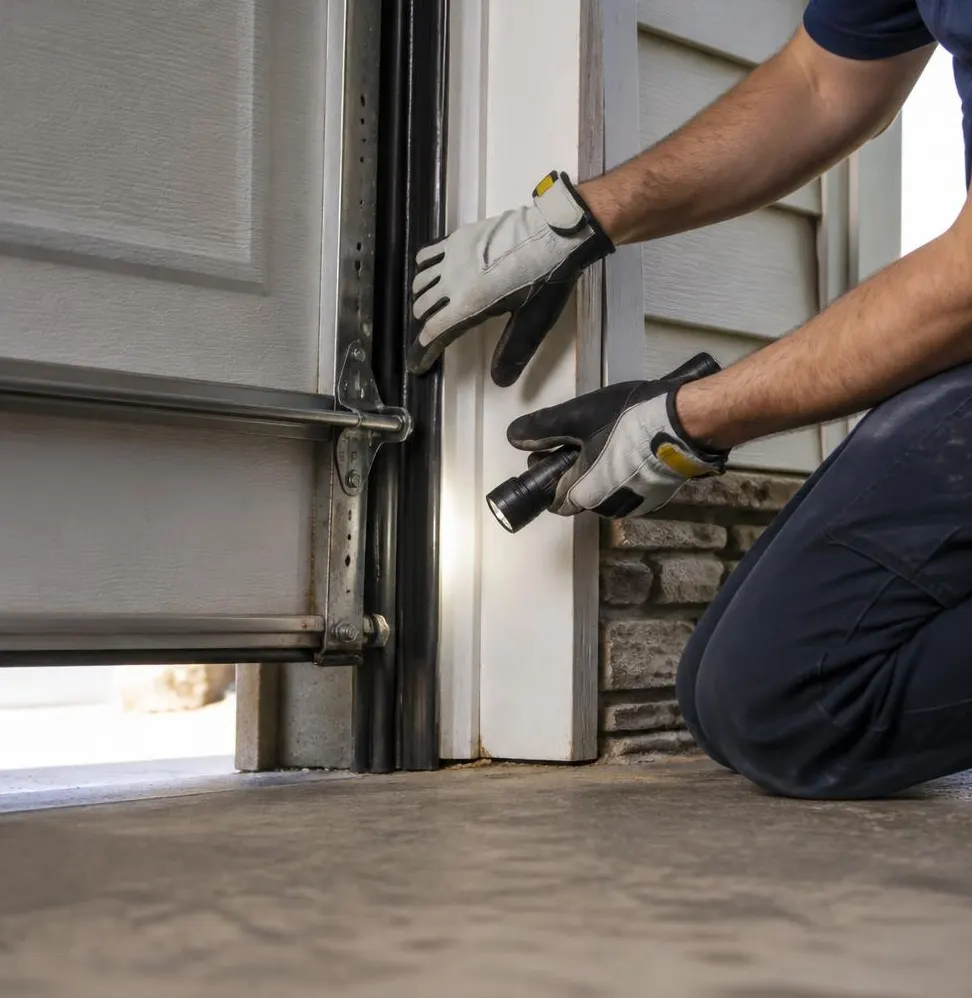
You hit the button on the way out the door, and nothing happens. No hum, no click, just silence. Or maybe the opener whirs but the door itself doesn't budge. Or it lifts six inches and stops, like something invisible is holding it down. Whatever the exact symptom, a stuck garage door always has a cause, and that cause usually shows up in a predictable order once you know where to look.
What You Might Be Noticing
Before getting into causes, it helps to pin down exactly what the door is doing, because that detail points a technician in the right direction fast:
- Total silence when you press the remote or wall button, no light, no motor sound.
- The opener motor runs, you hear it humming or clicking, but the door doesn't move at all.
- The door starts to lift, then reverses or stops partway and the opener light blinks.
- The door is physically heavy when you try to lift it by hand, or won't budge even with the opener disconnected.
- One side lifts faster than the other, or the door looks crooked as it tries to open.
The Order a Technician Checks Things
1. Power to the Opener
This sounds basic, but it's first for a reason: it's the most common fix and the fastest to rule out. A tripped breaker, an opener accidentally unplugged during garage cleanup, or a GFCI outlet that tripped after humidity or a power surge during a nor'easter can all cut power entirely. The fix here is simply resetting the breaker or outlet, no tools required.
2. The Remote and Wall Control
If the opener has power but doesn't respond, the next check is the remote itself. Dead batteries are the usual culprit, but on older systems the remote's internal code can also drift out of sync with the opener and need reprogramming. A technician will test the wall-mounted button separately from the handheld remote to isolate which one is actually failing.
3. The Safety Sensors
If the opener hums or clicks but the door won't move, or it opens partway and reverses, the photo-eye sensors near the bottom of the track are the next stop. These sensors sit low to the ground, which makes them vulnerable to road salt spray tracked in on tires, condensation during freeze-thaw swings, or just a stray box blocking the beam. A technician wipes the lenses, checks alignment, and confirms the small indicator lights are solid rather than blinking.
4. The Manual Lock
On doors with a manual locking bar, especially common on original doors in older Sussex County homes, it's easy for the lock to get engaged by accident, often by a door that's been bumped or by kids playing in the garage. This one's a quick visual check and an easy fix.
5. The Springs
If the door is heavy to lift by hand, or the opener strains and stalls partway up, a broken torsion or extension spring is the likely cause. Springs carry the full weight of the door, and in this region they take a beating from constant temperature swings between humid summers and icy winters. A snapped spring is often audible, a loud bang from the garage, sometimes mistaken for a dropped object. This repair requires replacing the spring itself, not just the opener, since the opener was never designed to lift the door's full weight alone.
6. The Cables and Pulleys
Closely tied to spring problems, frayed or snapped lift cables will cause the door to hang unevenly or drop suddenly on one side. This is checked right after springs because the two systems work together, and a failure in one often stresses the other.
7. The Track and Rollers
A bent track, a rusted roller, or ice buildup inside the track after a freeze-thaw cycle can physically block the door's path. This shows up as a door that opens unevenly or binds at a specific point every time. The fix ranges from realigning the track to replacing worn rollers.
8. The Opener's Internal Gear
Last on the list because it's the least common: a stripped plastic drive gear inside the opener unit itself. This produces a motor that runs but never engages the chain or belt. It's an internal part replacement, and on older opener units it sometimes makes more sense to replace the whole unit.
When to Call Precision Garage Door of Sparta
If you've checked the obvious, power, batteries, the lock, and the door still won't open, it's time to stop troubleshooting and call in a technician. This especially applies if the door feels unusually heavy, if you heard a bang before it stopped working, or if the opener is straining. Precision Garage Door of Sparta handles both spring replacement and garage door opener repair, and a technician can run through this full checklist in one visit rather than leaving you to guess at which part failed.
If your garage door in Sparta, Newton, Andover, or anywhere around Sussex County won't open, give Precision Garage Door of Sparta a call. We'll find the cause and get it moving again, safely and the first time.